














































Step-by-Step Nematode Application
Outdoors, the pests have already started nibbling on the first plants, so you've ordered nematodes from Green Guardia. A few days later, the beneficial organisms arrive. Now, the nematode application determines whether the roundworms can do their job properly. Because nematodes are live goods: they need the right timing, moist soil with a suitable temperature, and careful handling after delivery. In this guide, you'll learn what matters and which mistakes you can avoid.
Which nematodes match your pest?
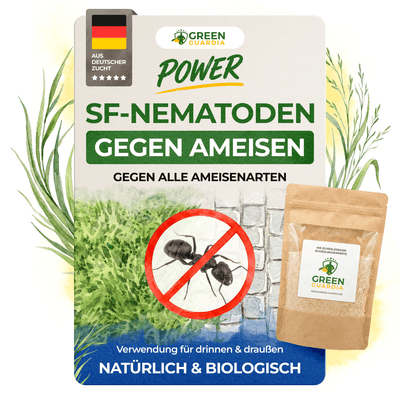
Before you can apply nematodes, you need to know which pest you want to combat. Each nematode species targets specific pests, and the abbreviation on the package tells you which ones. You can use SF nematodes against fungus gnats, ants, flea beetles, and the codling moth, among others. HB nematodes target vine weevils and chafers, PC nematodes target slugs and snails, and SC nematodes target mole crickets, crane flies, and cutworms. The same basic rules apply to the nematode application for all species, only the ideal soil temperature and best timing differ.
When to apply nematodes?
This question is mainly answered by the thermometer. Nematodes only become active in the soil when it is warm enough, and how warm depends on the species. Our SF nematodes against the codling moth work best at soil temperatures between 10 and 28 °C, while PC nematodes against slugs and snails work between 12 and 25 °C. Nematodes should not be applied to the soil during frost. You can find the exact values for your target pest on the respective product page.
The time of day also matters: Apply the beneficial organisms in the morning or evening. In the garden, spring and late summer are typical time windows. For the codling moth, the period right after fruit drop is particularly favorable because that is when the larvae overwinter in the soil.
When to apply nematodes if the infestation is severe?
As early as possible, as soon as the temperature is right. In case of a severe infestation, a second application after 7 to 14 days is advisable, depending on the product. Also, expect the effect to take some time, as the nematodes must first find the larvae in the soil.
Watering with nematodes: How to succeed in the garden bed and pot
Watering with nematodes works almost like regular watering. You mix the beneficial organisms into water and distribute the solution evenly over the soil around the affected plants or in the root zone. This works just as well in a garden bed as it does in a pot or tub.
After that comes the most important part: keep the soil consistently moist for at least two weeks before and after application. Simply watering with nematodes once and then stopping is not enough: if the soil dries out, the effect is wasted.
How to store nematodes?
You should only store nematodes briefly. It is best to apply them directly upon receipt. If you cannot start immediately, place the package in the refrigerator at a cool 4 to 8 °C and use the live goods within one week. Anyone who needs to store nematodes should therefore not leave them lying around longer than necessary.
Which mistakes hinder the effect?
The most common reason for a lack of success is soil that dries out during the first two weeks. Similarly, you should avoid overly cold soil and chemical plant protection products, as pesticides before or after application can harm the beneficial organisms.
The core rules in brief
Five rules are enough for a successful nematode application:
- Choose the species that matches your pest.
- Check the soil temperature, compare it with the product information, and refrain from applying during frost.
- Water with nematodes in the morning or evening.
- Keep the soil moist for two weeks.
- Store the delivery at 4 to 8 °C and use it within one week.
If you follow these tips, you will give the beneficial organisms the best starting conditions. In our shop, you will find the nematodes sorted by target pest, with suitable application instructions on each product page. Detailed step-by-step guides are also available in our user manuals.